From diagnosis silos to a holistic view – HOPE for multimorbid patients gives patients and care teams a shared

Multimorbidity is not the exception – it is the norm

In Sweden, more than 55 percent of everyone over 77 lives with two or more chronic conditions. Across Europe, over 30 percent of the population above 50 has multimorbidity, and the proportion rises sharply with age. The most common combinations include hypertension, diabetes, chronic kidney disease, atrial fibrillation, and dyslipidemia – conditions that each require monitoring, medication, and contact with healthcare. For the individual patient, this means multiple care contacts, conflicting treatment recommendations, and an overwhelming amount of information to manage. For healthcare, it means an organization not built for the whole – but for individual diagnoses, one at a time. Multimorbid patients have on average 12 percent higher total healthcare costs, and the fragmentation increases the risk of unnecessary emergency visits and readmissions.

CareMatrix – a European challenge to the market

CareMatrix is an EU-funded Horizon 2020 project for pre-commercial procurement (PCP) in which three European regions – Region Skåne in Sweden, Vestre Viken Hospital Trust in Norway, and Osakidetza – the Basque Country’s public healthcare service in Spain – jointly challenged the market to develop innovative solutions for integrated care in multimorbidity. The procurement attracted significant interest: 29 European consortia, comprising eHealth companies and research organizations from Sweden, Spain, Turkey, Canada, and Greece among others, submitted applications. Nine consortia – with a total of over 21 organizations – were selected for Phase 1. From there, a stepwise elimination followed: design and concept in Phase 1, prototype and development in Phase 2, and finally clinical field testing with real users in Phase 3. Two consortia out of 29 made it all the way – and ADDI Medical with its subcontractors was one of them.

While the other solutions consisted of consortia with three to five organizations, ADDI Medical participated as a single company – but with strong subcontractors that together covered the full technical breadth: InterSystems as specialists in system integration, CompuGroup Medical (CGM) as specialists in device integration, Scandinavian SCRO as specialists in clinical studies, and Hepro AS as implementation and support specialists in Norway. That a single Swedish eHealth company with its subcontractors goes the full distance in a European innovation procurement of this scale is something we are both grateful for and proud of – and clear proof of both technical maturity and clinical relevance.

HOPE for multimorbid patients – when clinical decision support meets patient-generated data

What makes HOPE for multimorbid patients unique is its ability to manage the interplay between diagnoses – not just each diagnosis in isolation. The service is built on a rule-based AI agent that combines clinical algorithms for chronic kidney disease (CKD), hypertension, diabetes, and atrial fibrillation in a shared decision matrix. When multiple conditions are flagged simultaneously – for example chronic kidney disease and hypertension – so-called trump rules are activated that automatically prioritize the highest risk level and suggest the appropriate action. In practice, this means the system does not simply alert for a single abnormal value, but weighs the patient’s overall risk profile and accounts for the fact that an action that is right for one diagnosis may be wrong for another.

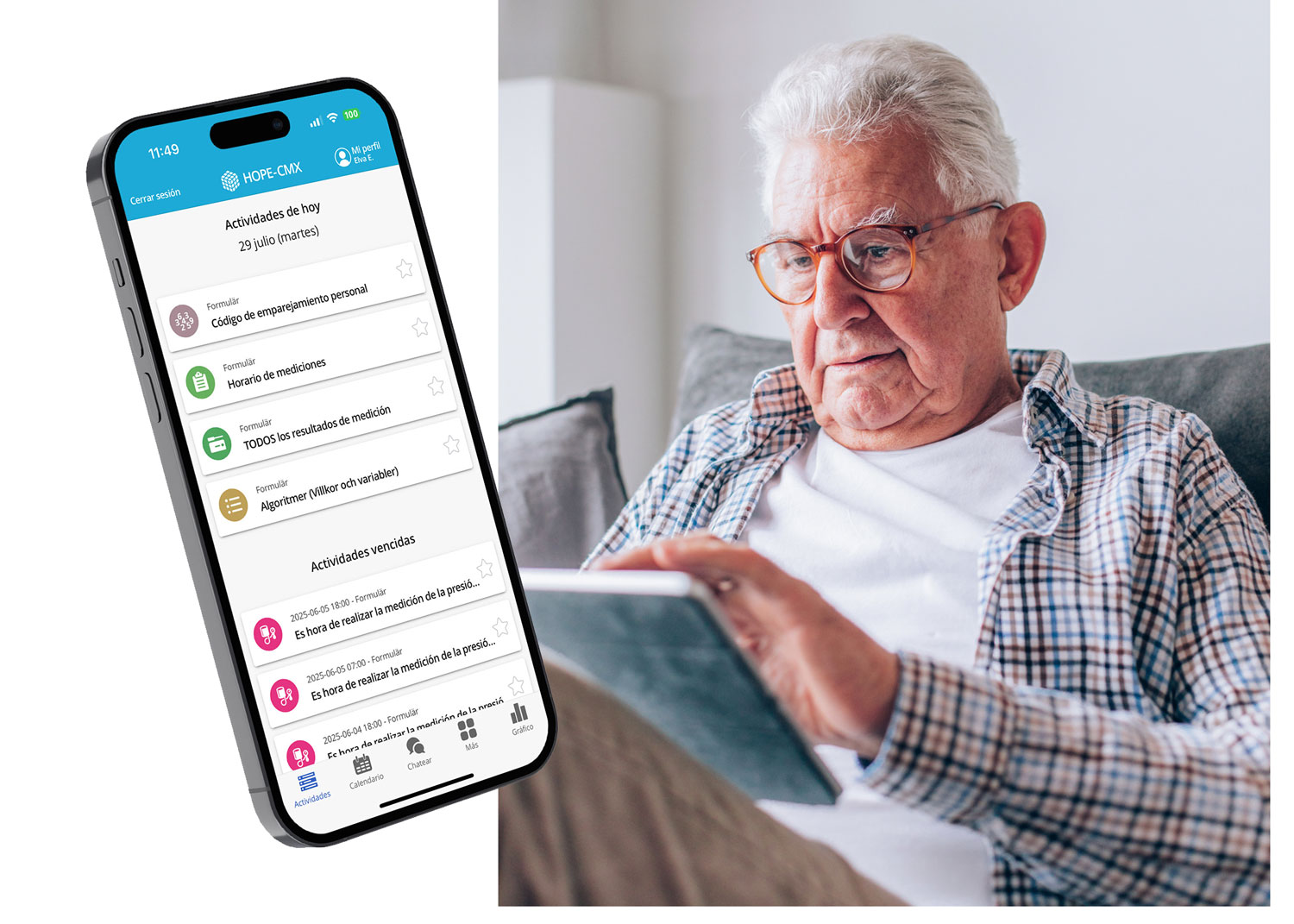
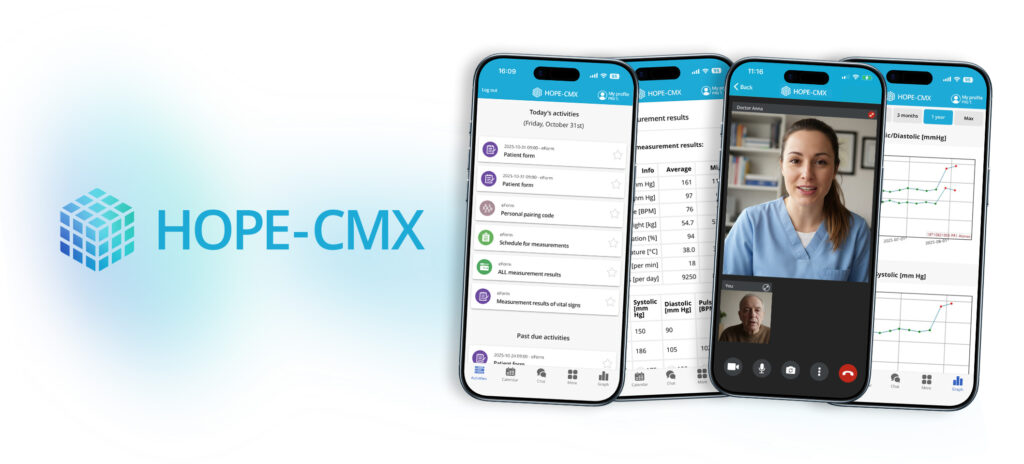
The patient registers symptoms and measurements from home via the HOPE app, connected to 4G-enabled medical devices for blood pressure, oxygen saturation, weight, temperature, blood glucose, and spirometry. All data flows in in real time and is evaluated against the individualized self-care plan. If blood pressure is too high in combination with declining kidney function, the risk level is automatically adjusted, and both patient and care team are notified of the next step. In this way, the gap between two visits is bridged – the period where deterioration otherwise goes undetected.

The patient as partner – not as passive recipient. Based on their registered values and symptoms, the patient automatically receives an individually tailored self-care plan – generated by HOPE without manual work from the clinic. The plan clearly shows what is normal, when the patient should act on their own, and when it is time to contact healthcare. Color-coded feedback in the app – green, yellow, red – makes it easy to understand where you stand, even for those living with multiple diagnoses simultaneously. Reminders, educational materials, and direct communication with the care team create a secure structure that makes the patient a true partner in their own care – not just someone who receives instructions at the next visit.

The difference from traditional care is fundamental. Instead of waiting for the next annual visit and hoping nothing deteriorates in the meantime, the patient receives daily feedback on their values and clear guidance on what they can do themselves. When the patient understands their situation, knows when to act, and feels confident doing so – then self-care becomes not just a concept but a way of working. It reduces anxiety, strengthens adherence, and prevents acute deterioration.

The care team gains overview instead of fragments

Via HOPE Practitioner, the interprofessional care team gets a consolidated dashboard with graphical trends, risk classification, and a dedicated decision support table showing the recommended next clinical action for each patient. Instead of chasing information across separate medical record systems, the team sees the full picture on one screen: kidney function trends over time, blood pressure progression, latest HbA1c, and whether there is an irregular heart rhythm that needs investigation – all in a single view. The care team can prioritize the right patient at the right time, and the patient no longer has to be the one holding their own care together. Previous experience from the HOPE platform shows that administrative work can be reduced by over 60 percent and that the number of physical visits can be reduced by 40–45 percent when digital monitoring and automated self-care plans are introduced.

From European field testing to commercial reality

In Phase 3 of CareMatrix, HOPE for multimorbid patients was clinically field tested across all three regions – Region Skåne, Vestre Viken Hospital Trust, and Osakidetza – and confirmed as intuitive, stable, and clinically relevant. Over 95 percent of planned test activities were completed without the need for technical support, and users quickly learned to work independently in the system.

But HOPE is not just a research project. The service is CE-marked and classified under MDR Class IIa, and is already commercialized.

I fas 3 av CareMatrix fälttestades HOPE Multisjuklighet kliniskt i samtliga tre regioner – Region Skåne, Vestre Viken helseföretak och Osakidetza – och bekräftades som intuitiv, stabil och kliniskt relevant. Över 95 procent av planerade testaktiviteterna genomfördes utan behov av teknisk support, och användare lärde sig snabbt att arbeta självständigt i systemet.

Från Region Skåne lyftes framför allt värdet av tidig identifiering: “Det vi saknat är ett verktyg som fångar upp försämring innan den blir akut – när patienten har flera diagnoser som påverkar varandra är det just i mellanrummet mellan besöken som riskerna uppstår,” konstaterade en kliniker under utvärderingen i Skåne. Från Vestre Viken helseföretak i Norge framhölls hur lösningen samlar det som tidigare var utspritt: “Vi har länge vetat att fragmenteringen är ett problem för multisjuka patienter – att nu kunna se njurfunktion, blodtryck och blodsockertrender i en och samma vy, och få beslutstöd som väger samman helheten, är precis vad vi efterfrågade,” beskrev en deltagare från det norska vårdteamet. Och från Osakidetza i Baskien betonades kopplingen mellan tidig upptäckt och behandling av allvarliga tillstånd: “För oss handlar det inte bara om monitorering – det handlar om att kunna agera tidigare och rättare när en patient med diabetes och njursjukdom samtidigt börjar försämras. Det är där de allvarliga komplikationerna kan förebyggas,” sammanfattade en läkare från den baskiska utvärderingen.

Men HOPE är inte bara ett forskningsprojekt. Tjänsten är CE-märkt och agerar under MDR klass IIa och är redan kommersialiserad.

Configurability is the key

HOPE is not a finished product for a single diagnosis – it is a configurable service where the clinic itself can shape care workflows, treatment escalation pathways, thresholds, and contact rules without programming. The same HOPE platform is already used for ROP screening, cystic fibrosis, IBD monitoring, and population screening. What makes the CareMatrix experience particularly valuable is that it demonstrates how HOPE can be configured for the most complex scenario of all – when chronic kidney disease, hypertension, diabetes, and atrial fibrillation converge in the same patient and the same self-care plan.

In summary, HOPE for multimorbid patients shows that it is possible to move from diagnosis silos to an integrated holistic view – where clinical decision support, automated self-care plans, and the patient’s own measurements meet in a shared platform. When the patient becomes a partner and the care team gains overview – then care is transformed for the most complex patients.

Vill du veta mer om våra lösningar?

Fyll i din e-post och/eller telefonnummer så hör vi av oss inom kort!